WM Stock Earnings: What the Price, Quote, and Dividend Mean
Beneath the Surface of WM's Q3: A Fortress Built on Trash, and the Cracks in its New Foundation
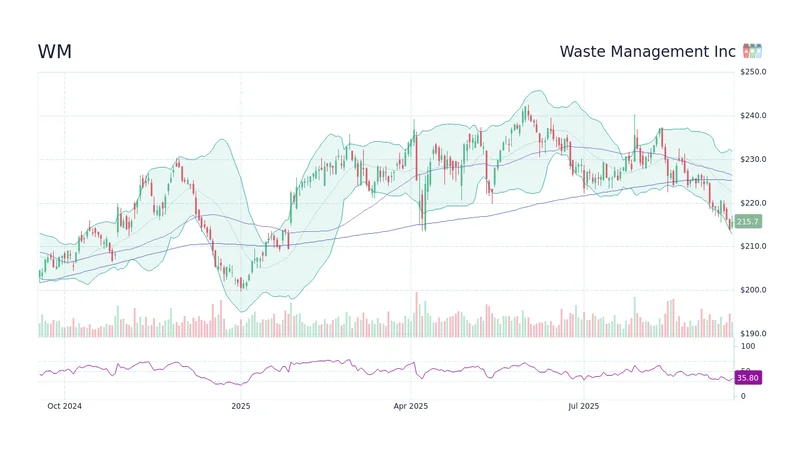
Another quarter, another earnings release from WM. On the surface, the numbers for the third quarter of 2025 look solid, almost reassuringly predictable for a company of its scale. Total revenue climbed to $6.443 billion, a jump of nearly 15%—to be more exact, 14.9%—from the same period last year. Adjusted operating EBITDA hit $1.970 billion, pushing the margin to a robust 30.6%, according to the company's WM Announces Third Quarter 2025 Earnings release. For the casual observer scanning the headlines that influence the `wm stock price today`, this all points to a healthy, growing enterprise.
But a headline is not an analysis. When you move past the aggregate figures and dissect the individual components of this massive operation, a far more complex and divergent picture emerges. The report doesn't describe one monolithic company; it describes two. The first is a tremendously powerful, high-margin utility that is performing at a record level. The second is a collection of newer, more volatile ventures that are facing significant headwinds. The entire story of WM right now, from its stock performance to its long-term strategy, hinges on how these two warring narratives resolve.
The Engine Room's Unstoppable Hum
Let's start with the core of the business: Collection and Disposal. This is the old-school, unglamorous work of picking up trash and putting it in a hole in the ground. And my god, is it profitable. The segment achieved a record adjusted operating EBITDA margin of 38.4% in the quarter. Read that again: 38.4%. This is the financial equivalent of a perfectly tuned industrial engine, humming away in the belly of a ship, utterly indifferent to the storm raging on the deck above. It generates immense, predictable cash flow with pricing power that most companies can only dream of.
This segment is WM’s fortress. Its performance is so dominant that it papers over weaknesses elsewhere, propping up the consolidated numbers and funding the company’s more ambitious projects. The cash flow data confirms this. Net cash from operating activities is up 12% over the first nine months of the year, hitting $4.35 billion. This isn’t just good; it’s the bedrock of the entire enterprise. It allows WM to invest in new recycling plants, build out its renewable natural gas (RNG) portfolio, and return capital to shareholders, which is a key factor for anyone tracking the `wm stock dividend`.
This core business is a beautiful, simple machine. But its very simplicity and strength make the struggles in other parts of the company all the more glaring. What happens when the capital generated by this fortress is deployed into less certain territory?
The Volatility on Deck
While the engine room hums, the situation on deck is messy. Look no further than the Recycling Processing and Sales segment, which saw its revenue plummet by $60 million. The cause was a nearly 35% year-over-year collapse in the blended average price for single stream commodities, which fell from around $101 per ton to just $68. This is a brutal reminder that, despite heavy investment in automation, the recycling business is not a utility. It’s a commodities play, subject to the violent whims of global markets. WM can build the most efficient sorting facility in the world, but it can’t control the price of recycled cardboard. Does this segment ever truly become a stable contributor, or is it destined to be a permanent source of volatility?
Then there’s the new prize: WM Healthcare Solutions, the business unit built from the pricey acquisition of Stericycle. The company’s official comment is that its revenue was "slightly below expectations." And this is the part of the report that I find genuinely puzzling. I’ve analyzed hundreds of post-acquisition filings, and "slightly below expectations" this early in an integration process (the deal was substantial, costing billions) is a carefully chosen phrase that almost never signals good news.
It raises immediate, critical questions that the report leaves unanswered. Is this a temporary hiccup related to the complexities of merging two massive organizations? Or does it point to a fundamental miscalculation about the market or the asset itself? We simply don't have the data, but for a segment that was supposed to be a key pillar of future growth, it’s a disconcerting start.
The contrast is stark. The old business prints money. The new businesses, recycling and healthcare, are either bleeding revenue or failing to meet initial targets. This divergence is the central tension in the WM story.
The Contradiction in the Outlook
This tension comes into sharp focus when you examine the company’s updated full-year guidance for 2025. Management lowered its total revenue projection to the low end of the prior range, an implicit admission that the headwinds in recycling and healthcare are real. Yet, in the same breath, they affirmed their guidance for adjusted operating EBITDA and free cash flow, and even increased their projected margin range.
How do you square that circle? It suggests a deliberate strategy: protect profitability at all costs, even if it means sacrificing top-line growth. They are likely shedding low-margin business or benefiting from the sheer weight of the high-margin Collection and Disposal segment. It’s a disciplined and rational move, but it’s also a quiet acknowledgment that the growth story isn’t playing out as planned.
This makes CEO Jim Fish’s projection that 2026 free cash flow will approach $3.8 billion all the more audacious. That would be a massive leap of nearly a billion dollars from the top end of the 2025 guidance. Is this a genuinely achievable target based on the ramp-up of their sustainability investments, like the new RNG facilities? Or is it a strategic move to keep investors focused on a bright future, drawing their attention away from the murky present? The answer will likely determine the direction of the `wm stock quote` for the next 18 months.
A Utility Wearing a Growth Stock's Clothing
My takeaway from this quarter is clear. WM is, at its core, one of the best utility-style businesses in North America. Its primary operation is a cash-generating fortress with a deep moat. The problem is that it's increasingly being valued and discussed as a dynamic, diversified growth company. The data simply doesn't support that narrative right now. The growth segments are proving to be volatile and challenging. Investors need to be honest with themselves about what they own: a remarkably stable, profitable trash company that is using its core strength to fund a series of high-stakes, uncertain bets on the future.

- Search
- Recently Published
-
- Duke Energy: What's Really Going On?
- Value City Furniture: Are they finally going out of business? The bankruptcy talk.
- Scott Bessent: Who Is This Guy, The Trump Whispers, And What Are They Not Telling Us?
- American Signature Files Chapter 11: What Happened?
- Tesla Ride-Hail in Arizona: What This Means for the Future of Mobility
- OECD: What it is, and its AI Data Focus
- Nebius: Stock, Coreweave, & Nvidia – What's the Real Deal?
- Bitcoin: Beyond the Headlines, What This Moment Truly Signals
- Social Security Retirement: The Realities of Your Payouts and How to Plan
- Starlink Satellites: How Many Are Really Up There, Where They're Hiding, & What's The Actual Point?
- Tag list
-
- carbon trading (2)
- financial innovation (2)
- blockchain technology (2)
- carbon tokens (2)
- Blockchain (11)
- Decentralization (5)
- Smart Contracts (4)
- Cryptocurrency (26)
- DeFi (5)
- Bitcoin (29)
- Trump (5)
- Ethereum (8)
- Pudgy Penguins (5)
- NFT (5)
- Solana (7)
- cryptocurrency (6)
- XRP (3)
- Airdrop (3)
- MicroStrategy (3)
- Stablecoin (3)
- Digital Assets (3)
- PENGU (3)
- Aster (8)
- Zcash (6)
- iren stock (3)