Zcash's Sudden Resurgence: Why It's Trending and What It Means for the Future of Privacy
I have to admit, when I saw the Zcash chart last week, I did a double-take. Then I just sat back in my chair, a slow smile spreading across my face. This is the kind of breakthrough that reminds me why I got into this field in the first place. We’re not just watching a number go up on a screen; we are witnessing a powerful, resonant signal emerge from the noise of the market. A declaration.
For years, the conversation around digital currency has been dominated by a single, public-by-default model. Bitcoin, for all its revolutionary brilliance, gave us a system of pseudonymous transparency. Every transaction, a permanent entry on a global ledger for anyone to see. We accepted this as the price of admission. But what if that was never the endgame? What if it was just the prototype?
Zcash, a project that has been quietly, diligently building since 2016, is suddenly roaring back to life. A surge to $165, its highest point since 2022, and a staggering 240% climb in just two weeks. But forget the price for a moment. The price is just the symptom. The real story, the one that should have you sitting on the edge of your seat, is why this is happening now. It’s a story about a fundamental human need we almost forgot we had: the right to privacy.
The Chorus of Conviction
When a handful of the brightest minds in technology and finance all start pointing at the same thing, you’d be a fool not to pay attention. This isn’t the usual cacophony of market hype. This is a chorus of conviction.
We’re seeing people like Naval Ravikant, a venture capitalist whose insights have shaped a generation of entrepreneurs, call Zcash “insurance against Bitcoin” to his millions of followers. Think about that framing. Not an alternative, but insurance. It’s a profound recognition that a transparent financial system, while useful, is incomplete. It lacks the one thing every free society needs: a space for private, consensual exchange.
Then you have Mert Mumtaz, the CEO of Helius Labs, who isn’t just bullish; he’s articulating a powerful vision. He points to Zcash’s superior privacy design, the influx of new talent, and a battle-hardened community that never gave up. His prediction of a potential $1,000 price target isn't just wild speculation; it's an extrapolation based on a belief that the market is finally waking up to the technology's true value. Of course, he rightly warns of the risk—this is the frontier, after all—but his excitement is palpable.
This isn’t just about making transactions invisible. It’s about leveraging one of the most elegant breakthroughs in modern cryptography: zero-knowledge proofs. Or, in simpler terms, the ability to prove something is true without revealing the underlying information that makes it true. Imagine being able to prove you have a valid driver's license without showing your name, address, or date of birth. That’s the magic we’re talking about here, and Zcash has been pioneering its application for finance since day one. The amount of ZEC being "shielded" in these private transactions is growing, a quiet but steady signal that users are voting with their assets for a more confidential future.
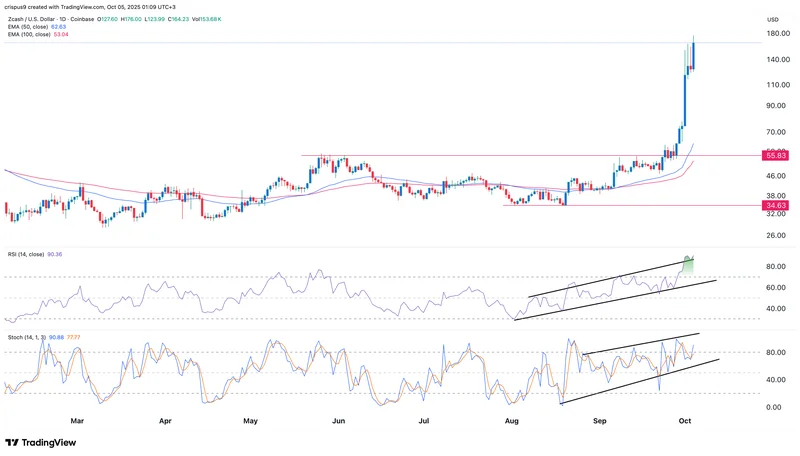
Why Is Everyone Suddenly Talking About Privacy Coin Zcash Again? Are we finally seeing the market catch up to a fundamental human truth?
A Blueprint for a Better Internet
For the longest time, we’ve been told that to participate in the digital world, we must give up our privacy. Our data, our transactions, our associations—all of it became fodder for corporate and state surveillance. It's a bargain that has felt increasingly Faustian. Zcash, and the philosophy it represents, offers us a different path.
The investment thesis from Chris Burniske’s firm, Placeholder, puts it perfectly. The goal was never just to be “Bitcoin but with privacy.” The goal was to improve on Bitcoin’s core design, to build a system that offered a choice. A system where you, the user, decide what is public and what is private. This is the digital equivalent of choosing between a public town square announcement and a private, whispered conversation. Both are essential for a functioning society, yet in the digital realm, we’ve only ever had the town square.
This feels like the early days of personal encryption in the 1990s. Back then, tools like PGP (Pretty Good Privacy) were seen by some as niche, even subversive. The government fought to classify the software as a munition. But a small, passionate group of cypherpunks understood a profound truth: in a digital age, strong encryption was not a weapon, but a shield. It was a fundamental tool for free speech, for commerce, for liberty itself. They were right. Today, encryption protects everything from our bank accounts to our private messages.
We are at a similar inflection point now with financial privacy. The idea of a shielded transaction is not about hiding illicit activity; it’s about restoring the normal state of commerce that has existed for millennia. It’s about the freedom to buy a book, donate to a cause, or pay an employee without broadcasting it to the entire world. This is the kind of foundational technology that doesn’t just create a new asset—it creates new possibilities for how we organize ourselves, how we build businesses, and how we define our relationship with a digital state. It’s a paradigm shift hiding in plain sight, and the speed of this reawakening is just staggering—it means the gap between the internet we have and the internet we deserve is closing faster than we can even comprehend.
Of course, with this power comes immense responsibility. A world with true financial privacy requires us to be more vigilant, to build new systems of trust, and to hold ourselves to a higher ethical standard. But is the alternative—a world of total financial surveillance—really a future any of us want to live in?
A Choice We Finally Get to Make
For over a decade, we were presented with a false dichotomy: accept a transparent, traceable digital economy or be left behind. What we’re seeing with Zcash is the dawn of a third option. It’s not a replacement for Bitcoin, but a vital complement to it. It’s the realization that a mature digital ecosystem, like any healthy ecosystem, requires diversity. We need public spaces and we need private ones. We need transparency and we need confidentiality. What Zcash offers isn't an ideology to be imposed, but a choice to be made, freely and individually. And for the first time in a long time, that’s a choice that feels truly revolutionary.

- Search
- Recently Published
-
- Duke Energy: What's Really Going On?
- Value City Furniture: Are they finally going out of business? The bankruptcy talk.
- Scott Bessent: Who Is This Guy, The Trump Whispers, And What Are They Not Telling Us?
- American Signature Files Chapter 11: What Happened?
- Tesla Ride-Hail in Arizona: What This Means for the Future of Mobility
- OECD: What it is, and its AI Data Focus
- Nebius: Stock, Coreweave, & Nvidia – What's the Real Deal?
- Bitcoin: Beyond the Headlines, What This Moment Truly Signals
- Social Security Retirement: The Realities of Your Payouts and How to Plan
- Starlink Satellites: How Many Are Really Up There, Where They're Hiding, & What's The Actual Point?
- Tag list
-
- carbon trading (2)
- financial innovation (2)
- blockchain technology (2)
- carbon tokens (2)
- Blockchain (11)
- Decentralization (5)
- Smart Contracts (4)
- Cryptocurrency (26)
- DeFi (5)
- Bitcoin (29)
- Trump (5)
- Ethereum (8)
- Pudgy Penguins (5)
- NFT (5)
- Solana (7)
- cryptocurrency (6)
- XRP (3)
- Airdrop (3)
- MicroStrategy (3)
- Stablecoin (3)
- Digital Assets (3)
- PENGU (3)
- Aster (8)
- Zcash (6)
- iren stock (3)