Eli Lilly's Insane Stock Surge: What's Behind the Hype and Why It's Probably a Bubble
So, Eli Lilly just dropped its third-quarter numbers on October 30th, and the entire financial media machine is tripping over itself to tell you what it all means. Analysts are adjusting their little spreadsheets, traders are mashing their keyboards, and everyone’s pretending they saw this coming.
Give me a break.
Let’s be real for a second. The run-up to this earnings report was a complete circus. A masterclass in how Wall Street has gamified the economy into a high-stakes guessing game that benefits absolutely no one except the people running the casino. It's just noise. No, it's worse than noise—it's a distraction machine designed to make you feel like you need to do something right now, or you'll miss out.
And honestly, watching it all unfold is my favorite kind of spectator sport.
The Pre-Game Hype Was a Joke
Remember last week? The articles were flying. "Should You Buy Eli Lilly Stock Before Oct. 30?" they asked, with all the faux-urgency of a late-night infomercial. Wall Street’s finest minds were trotted out to give their "expert" predictions, and it was pure comedy.
They all agreed revenue would be huge—around $16 billion, a 40% jump from last year. Duh. You don't need a Wharton degree to know that Zepbound and Mounjaro, the company's superstar weight-loss and diabetes drugs, are printing money. They account for over half the company’s revenue. Figuring that out is like predicting the sun will rise.
But when it came to earnings per share—the actual profit—the "experts" were completely lost. The average estimate was $5.92. But the range? It went from a pessimistic $5.49 all the way up to a wildly optimistic $7.21. That’s not a forecast; that’s a shrug. It’s like a weatherman predicting the temperature tomorrow will be somewhere between "light jacket" and "surface of the sun." What are we, the retail investors, supposed to do with that information? Flip a coin?
This whole analyst prediction game is a charade. They build these intricate models, talk about discounted cash flows, and then throw a number out there that's so broad it's functionally useless. Are we supposed to be impressed by this? Is this the grand financial wisdom we're paying for through our 401k fees?
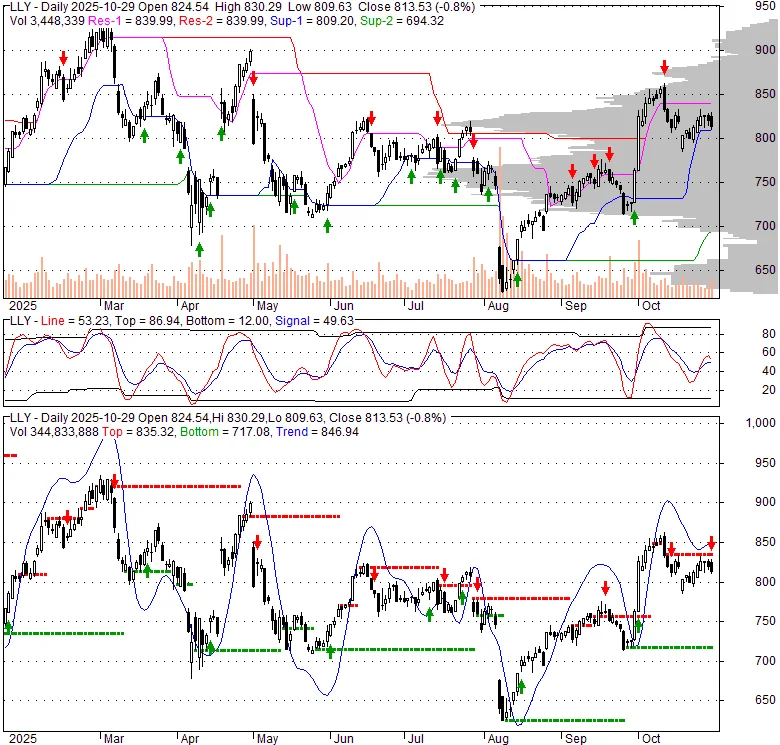
And the best part? Even when the company delivered its numbers, history told us the stock’s reaction would be a crapshoot. Over the last four quarters, Lilly beat estimates twice and missed twice. You’d think the stock would follow a simple beat-goes-up, miss-goes-down pattern. But you'd be wrong. In Q1 of this year, they missed the consensus estimate by almost 6%, and the stock went up. Then in Q2, they crushed the estimate by nearly 13%, and the stock… went down.
It makes absolutely no sense. It's a market that seems to run on vibes, whispers, and algorithms that have more mood swings than a teenager. And we’re all sitting here, staring at the ticker like it's some sacred text that will reveal the secrets of the universe, and for what, exactly...
So, The Numbers Dropped. Now What?
So, October 30th rolls around. The big reveal. And Eli Lilly didn't just beat estimates; it took them out behind the woodshed. Sales of Zepbound and Mounjaro went stratospheric, the company blew past even the most optimistic earnings predictions, and they hiked their guidance for the future. By every conceivable metric, it was a home run. A grand slam.
The stock, offcourse, jumped in pre-market trading. This time, just this once, the market reacted logically. A broken clock is right twice a day, I guess.
But this outcome doesn't vindicate the pre-earnings hype. It exposes it. The people who frantically bought the stock on October 29th based on a hunch got lucky. The ones who sold because they were spooked by the wide analyst range look like fools today. Both were just gambling.
The only sane advice in that whole pre-earnings article was buried at the very end: "Think long term." If you believe in the company's product pipeline—and with the obesity drug market looking like the next gold rush, it's hard not to—then who cares about a single day's report? Whether you bought on October 29th or October 31st won't matter a damn bit in 2035. The tiny blip on the chart will be invisible.
This obsession with quarterly earnings is a sickness. It forces companies into short-sighted decisions to please a bunch of analysts who can’t even agree on a profit forecast. It turns investing, which should be a patient, long-term strategy, into a frantic, high-anxiety video game. It's why my own retirement account looks less like a carefully tended garden and more like a seismograph printout. And for what? So a handful of people in expensive suits can feel important for a day? I ain't buying it.
So We're All Just Guessing, Right?
Let's just call this what it is: a casino. The house always wins, and the rest of us are just pulling levers and hoping for a jackpot. Eli Lilly had a fantastic quarter, and that's great for them and for the people their drugs help. But don't let anyone tell you they knew exactly how this would play out. They didn't. They were guessing, just like the rest of us. The only difference is they get paid millions to do it.

- Search
- Recently Published
-
- Duke Energy: What's Really Going On?
- Value City Furniture: Are they finally going out of business? The bankruptcy talk.
- Scott Bessent: Who Is This Guy, The Trump Whispers, And What Are They Not Telling Us?
- American Signature Files Chapter 11: What Happened?
- Tesla Ride-Hail in Arizona: What This Means for the Future of Mobility
- OECD: What it is, and its AI Data Focus
- Nebius: Stock, Coreweave, & Nvidia – What's the Real Deal?
- Bitcoin: Beyond the Headlines, What This Moment Truly Signals
- Social Security Retirement: The Realities of Your Payouts and How to Plan
- Starlink Satellites: How Many Are Really Up There, Where They're Hiding, & What's The Actual Point?
- Tag list
-
- carbon trading (2)
- financial innovation (2)
- blockchain technology (2)
- carbon tokens (2)
- Blockchain (11)
- Decentralization (5)
- Smart Contracts (4)
- Cryptocurrency (26)
- DeFi (5)
- Bitcoin (29)
- Trump (5)
- Ethereum (8)
- Pudgy Penguins (5)
- NFT (5)
- Solana (7)
- cryptocurrency (6)
- XRP (3)
- Airdrop (3)
- MicroStrategy (3)
- Stablecoin (3)
- Digital Assets (3)
- PENGU (3)
- Aster (8)
- Zcash (6)
- iren stock (3)