Carvana Stock (CVNA): What Its Price Action Reveals About the Future of Tech
Carvana's Q3 Wasn't Just a Record Quarter—It Was a Glimpse Into the Future of Commerce
Let's be honest. For decades, buying a used car has been a universally dreaded experience. It’s a gauntlet of fluorescent-lit showrooms, questionable coffee, and the slow, grinding pressure of a salesperson trying to “get you into this beauty today.” It’s an industry that felt permanently stuck in the 1980s, a relic of an analog world we’d otherwise left behind.
Then, the numbers for Carvana’s third quarter of 2025 hit my screen. When I saw the report, with a $5.65 billion revenue figure and 156,000 cars sold to families and individuals in just three months, I honestly had to double-check the ticker. This wasn't just another strong earnings report. This was a signal flare, a data point so powerful it feels like a declaration that the old world is officially over (Carvana Reports Record Q3 Revenue of $5.65B, Up 55%). We're witnessing an escape velocity event, and what's taking off isn't just a company; it's a whole new way of thinking about commerce itself.
Because here’s the big idea, the one that I think so many people are still missing: Carvana isn't a car dealer. Not really. It’s a vertically integrated logistics, data, and finance company that just happens to use cars as its medium. It’s applying a 21st-century operating system to a 20th-century industry, and the results are a paradigm shift we're only beginning to understand.
It's Not About the Cars, It's About the System
When Carvana’s leadership talks about their “vertically integrated model,” it sounds like typical corporate jargon. But what it actually means is revolutionary. In simpler terms, it means they control everything. From acquiring thousands of vehicles through their ADESA auction network, to inspecting and reconditioning them at massive industrial centers, to underwriting the loans with their own data models, and finally, to delivering that car right to your driveway with one of their iconic haulers.
This is the kind of breakthrough that reminds me why I got into this field in the first place. This end-to-end control is Carvana’s true product. The traditional car sales model is like a bunch of street musicians all playing different songs on the same corner—the auction house, the trucking company, the dealership, the local bank, the DMV. It’s a chaotic, inefficient mess. Carvana, by contrast, is a perfectly tuned orchestra conducted by a single maestro: its own software. Every step is a data point, every movement is optimized. They’ve reduced transport miles by 20% just by intelligently integrating their reconditioning centers. This isn't just about customer convenience; it’s about building a logistical machine so efficient that the old model simply can't compete.
Think of it like this: Amazon didn't just build a better bookstore; it built a global fulfillment network that could sell anything. Carvana is doing the same for the used vehicle market. They’re building the rails, the engines, and the software for an entirely new kind of automotive commerce. The question is, once you’ve built an engine that can process, finance, and deliver a two-ton, mechanically complex machine to any home in America, what else can that engine do? How long until this model is applied to RVs, boats, or even heavy industrial equipment?
Why the Skeptics Are Missing the Paradigm Shift
Of course, not everyone sees this future. I read that famed investor Jim Chanos remains short the stock, pointing to "red flags" like rising delinquencies in the broader auto market and the struggles of competitors. And from a certain point of view, he’s not wrong to be cautious. But I believe he’s looking at a rocket ship and judging it by the rules of road travel.
The skepticism focuses on macro headwinds and traditional credit risk, but it misses the technological moat Carvana is building. When a competitor like Tricolor Holdings collapses, the old guard sees industry-wide weakness. I see evidence that only the most technologically advanced, data-driven platforms will survive. Carvana’s finance operation isn't just a bank; it’s a data-science powerhouse. It’s collecting millions of data points on vehicle depreciation, repair costs, and consumer behavior to underwrite loans with a precision that was impossible a decade ago. Are we really judging this new, data-driven model by the same metrics we used for a dealership that relied on a FICO score and a gut feeling?
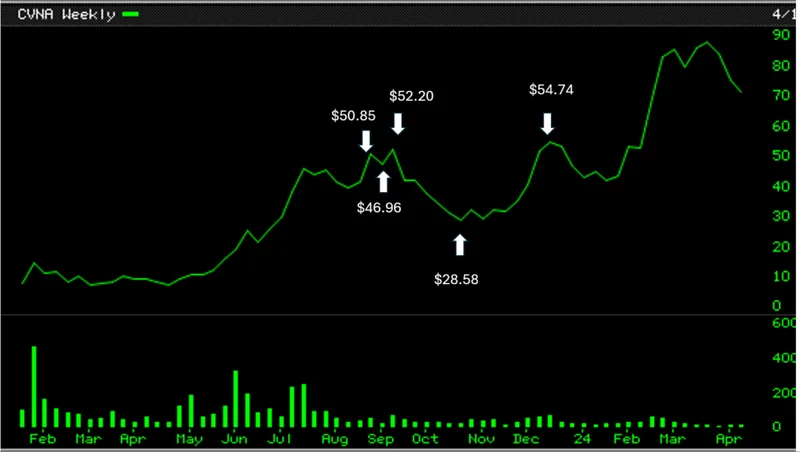
This reminds me of the early days of the internet, when skeptics scoffed at companies spending millions on servers and websites with no clear path to profit. They were measuring the new world with the yardsticks of the old. Carvana’s path is crystal clear: its six straight profitable quarters and record margins prove the model works. The real story isn't about whether the cvna stock price will dip next week; it’s about the fundamental rewiring of a multi-trillion-dollar industry.
So as we watch Carvana ramp up its advertising spend and push toward its audacious goal of selling 3 million cars a year, we have to ask ourselves what we’re really seeing. Is it just a company getting bigger, or is it a system reaching its full potential? This isn't just about selling more cars it's about building a logistical and data-driven nervous system for the entire used vehicle ecosystem a platform so efficient it makes the old model look like it's running on steam power.
Imagine, for a moment, the final step. You’ve spent a few hours online, found the perfect car, and handled the financing with a few clicks. The next day, you hear the quiet hum of a truck outside. It’s the Carvana hauler, its glass sides glowing, lowering your car to the street not as a simple delivery, but as the final, elegant output of a massively complex and intelligent system. That single moment is the culmination of data science, logistics, and a complete reimagining of what it means to buy something. It’s a moment of quiet, frictionless magic. With this much data and market power, however, comes a profound responsibility—a duty to protect customer data and ensure fairness in an industry that has historically been anything but.
The Algorithm of Everything
What Carvana has truly built is a blueprint. They’ve demonstrated that even the most complex, physical, and stubbornly analog industries can be completely transformed into a unified, data-driven, and radically efficient system. This was never just about cars. It’s about proving a concept: that with the right technology and an audacious vision, you can build a better machine for commerce itself. And that machine is just getting warmed up.

- Search
- Recently Published
-
- Duke Energy: What's Really Going On?
- Value City Furniture: Are they finally going out of business? The bankruptcy talk.
- Scott Bessent: Who Is This Guy, The Trump Whispers, And What Are They Not Telling Us?
- American Signature Files Chapter 11: What Happened?
- Tesla Ride-Hail in Arizona: What This Means for the Future of Mobility
- OECD: What it is, and its AI Data Focus
- Nebius: Stock, Coreweave, & Nvidia – What's the Real Deal?
- Bitcoin: Beyond the Headlines, What This Moment Truly Signals
- Social Security Retirement: The Realities of Your Payouts and How to Plan
- Starlink Satellites: How Many Are Really Up There, Where They're Hiding, & What's The Actual Point?
- Tag list
-
- carbon trading (2)
- financial innovation (2)
- blockchain technology (2)
- carbon tokens (2)
- Blockchain (11)
- Decentralization (5)
- Smart Contracts (4)
- Cryptocurrency (26)
- DeFi (5)
- Bitcoin (29)
- Trump (5)
- Ethereum (8)
- Pudgy Penguins (5)
- NFT (5)
- Solana (7)
- cryptocurrency (6)
- XRP (3)
- Airdrop (3)
- MicroStrategy (3)
- Stablecoin (3)
- Digital Assets (3)
- PENGU (3)
- Aster (8)
- Zcash (6)
- iren stock (3)