Etsy's Stock Tumble: Why This Isn't a Crisis, But a Glimpse Into the Future of E-Commerce
Etsy's Shocking Plunge Isn't a Crisis—It's a Crossroads for the Soul of E-Commerce
When I saw headlines like Etsy stock sinks on mixed earnings, CEO change — growth chief to replace Silverman flash across my screen, my first thought wasn't about the stock price. It wasn't about the 10% nosedive or the eye-watering $300 million in trading volume. No, seeing the news that Etsy CEO Josh Silverman was stepping down, I honestly just sat back in my chair and thought about the soul of the platform. Because what we just witnessed wasn't a simple market panic or another changing of the guard in the C-suite. It was a tremor, a signal from the collective consciousness of the market that something fundamental is at stake for one of the last bastions of human-scale commerce on the internet.
The knee-jerk reaction from Wall Street was predictable. A successful CEO announces his departure after eight years, and the algorithms and traders do what they're programmed to do: sell. They see uncertainty and they run for the exits. But if you, like me, look past the flashing red ticker, you see a story that is far more fascinating, and frankly, far more hopeful.
You see a paradox. On the one hand, a company whose stock is getting hammered. On the other, a company that just beat earnings expectations, pulling in $0.63 a share when the consensus was $0.52. They beat revenue forecasts, too. The engine is running, the lights are on, and people are still flocking to the site to buy unique, handcrafted goods. So what gives? Why the disconnect? Is this just a fleeting panic, or is the market sensing a deeper identity crisis that the balance sheet can’t show?
The Story Beneath the Numbers
To understand what’s happening, you have to look at the data that whispers instead of shouts. The insider trading reports, for instance, are jarring. In the last six months, executives have made 48 sales of Etsy stock and zero—that’s right, zero—purchases. Silverman himself sold nearly $43 million worth of shares. On the surface, it looks like a vote of no confidence from the very people who should believe in the company the most.
But I think that’s too simple a reading. This isn’t just about money. This is about a journey, and perhaps, the end of a specific chapter. Josh Silverman’s era was defined by one thing: scale. He took a beloved, quirky marketplace and transformed it into a global e-commerce powerhouse, a publicly-traded giant. He professionalized it, optimized it, and made it a legitimate competitor. And for that, he deserves immense credit.
Yet, this is where the tension lies. Etsy’s magic, its entire reason for being, is its opposition to industrial scale. It’s the digital equivalent of the Arts and Crafts movement a century ago, a rebellion against the soullessness of the factory floor. It’s a platform built on the promise of a human connection—that the beautiful wooden bowl you just bought was carved by a real person with a story. Silverman’s challenge was to grow the platform without killing that spirit. It’s like trying to turn a single master artisan’s workshop into a global factory without losing the craft. At a certain point, the sheer scale begins to strain the original promise.
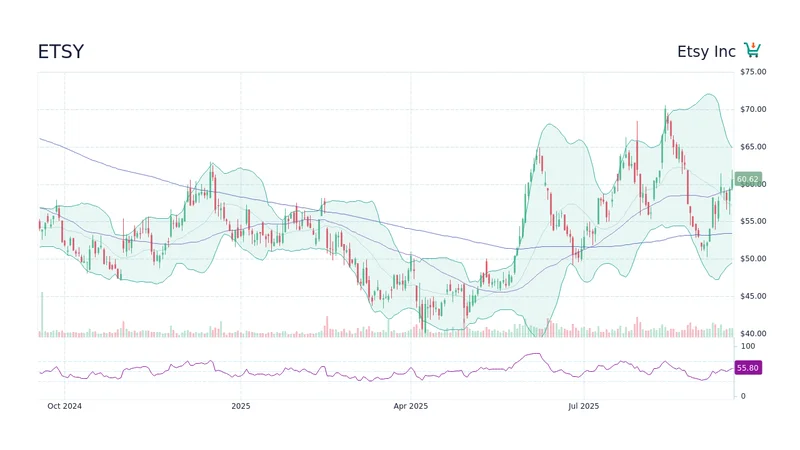
When I see that stock drop, I don't see a failure. I see a profound, subconscious market referendum on that very tension. The market is asking: Can Etsy continue to grow exponentially and still feel like Etsy? Can it serve millions of buyers and sellers without becoming just another algorithm-driven marketplace, indistinguishable from its competitors?
The Artisan's Apprentice Takes the Helm
This is why the succession plan is the most exciting part of this whole story. The board didn't bring in a slick outsider from Amazon or Google to further optimize the machine. They promoted from within. Kruti Patel Goyal, the current President and Chief Growth Officer, is stepping into the role. This isn't a pivot; it's a doubling down on the company's internal culture and DNA. She’s an operator who knows the playbook, who has been instrumental in the platform's growth.
This is the kind of breakthrough that reminds me why I got into this field in the first place—because technology is ultimately about people. The choice of Goyal suggests a commitment to evolution, not a radical overhaul. It signals that the leadership understands the delicate balance they must maintain. Her challenge isn't just about increasing Gross Merchandise Sales—which, in simpler terms, is just the total dollar value of everything sold on the platform. Her real test will be to nurture the ecosystem of creators.
Imagine a future where Etsy uses its scale not to homogenize, but to empower. A platform that uses AI not just to push sales, but to tell the stories of its sellers better than ever before, connecting a buyer in Tokyo with a leatherworker in Ohio on a deeply human level. That’s the incredible opportunity here—the chance to prove that a massive tech company can have a soul and that it can build a global marketplace that feels local, personal, and profoundly human, which is a paradigm shift we desperately need in an increasingly automated world.
This transition carries with it a tremendous responsibility. Etsy isn’t just a company; it’s the primary source of income for millions of independent artists and craftspeople. Goyal’s primary duty isn't to the stock price, but to them. If she can re-center the platform on empowering those creators, the market will eventually follow. What does success look like for her? It's not just a rising stock, but a thriving, diverse, and creative community of sellers who feel seen and supported.
It's Time to Rebuild the Workshop
Let’s be clear: Wall Street’s panic is a gift. It’s a loud, clear, and expensive signal that the world doesn't want another Amazon. It wants Etsy to be Etsy. This leadership change isn’t the end of a successful era; it’s the critical, necessary beginning of a new one. It's a chance to take all the power and scale built over the last eight years and infuse it with the original, rebellious, human-centric spirit that made us fall in love with the platform in the first place. This isn't a crisis. It's a clarification of the mission.

- Search
- Recently Published
-
- Duke Energy: What's Really Going On?
- Value City Furniture: Are they finally going out of business? The bankruptcy talk.
- Scott Bessent: Who Is This Guy, The Trump Whispers, And What Are They Not Telling Us?
- American Signature Files Chapter 11: What Happened?
- Tesla Ride-Hail in Arizona: What This Means for the Future of Mobility
- OECD: What it is, and its AI Data Focus
- Nebius: Stock, Coreweave, & Nvidia – What's the Real Deal?
- Bitcoin: Beyond the Headlines, What This Moment Truly Signals
- Social Security Retirement: The Realities of Your Payouts and How to Plan
- Starlink Satellites: How Many Are Really Up There, Where They're Hiding, & What's The Actual Point?
- Tag list
-
- carbon trading (2)
- financial innovation (2)
- blockchain technology (2)
- carbon tokens (2)
- Blockchain (11)
- Decentralization (5)
- Smart Contracts (4)
- Cryptocurrency (26)
- DeFi (5)
- Bitcoin (29)
- Trump (5)
- Ethereum (8)
- Pudgy Penguins (5)
- NFT (5)
- Solana (7)
- cryptocurrency (6)
- XRP (3)
- Airdrop (3)
- MicroStrategy (3)
- Stablecoin (3)
- Digital Assets (3)
- PENGU (3)
- Aster (8)
- Zcash (6)
- iren stock (3)