Nvidia CEO Jensen Huang on Tariffs: An Analysis of the Economic Reality vs. the AI Hype
It’s rare to see a CEO of a $4 trillion company engage in direct political attribution, but that’s precisely what Jensen Huang did on Sunday. His comments, summarized in a Fox Business report headlined Nvidia CEO touts new AI 'industrial revolution,' praises Trump tariffs for role in chip production, constructed a clean, linear narrative: President Trump’s tariffs were the “pressing agent” that led to Nvidia and TSMC manufacturing the world’s most advanced AI chips on American soil.
It’s a powerful story. It’s also a remarkable simplification of a far more complex economic and geopolitical reality.
As an analyst, when I see a narrative this tidy, my first instinct is to check the footnotes. The story presented is that tariffs created the pressure, and a new industrial revolution is the result. But this causal chain conveniently omits the single largest variable in the equation: the CHIPS and Science Act, a $52.7 billion firehose of government subsidies signed into law by the Biden administration. To ignore its role is like describing a championship victory by only talking about the pre-game speech, while completely ignoring the star player’s performance.
The decision for a firm like Taiwan Semiconductor Manufacturing (TSMC) to build a multi-billion-dollar fabrication plant in Arizona is not made lightly. It’s a decade-long commitment involving staggering capital expenditure (the Arizona project is now a $65 billion commitment). While tariffs on Chinese goods certainly altered global supply chain calculations, they were a blunt instrument. The CHIPS Act, in contrast, was a surgical injection of direct financial incentives. So, the key question isn't whether Trump's policies had an effect, but why Huang is choosing to frame them as the primary catalyst. What is the strategic value of this specific narrative, at this specific time?
The Anatomy of a Projection
Huang’s interview was packed with the kind of grand, forward-looking statements that define a market mania. He declared the dawn of a new “industrial revolution” and projected that within the next three to four years, about $500 billion worth of AI supercomputing technology could be manufactured and installed in the United States.
Let’s pause on that number for a moment. Five hundred billion dollars. It’s a figure so immense it almost loses meaning. Is this a total addressable market (TAM) forecast? A projection of capital expenditure? Does it include the cost of the data centers, the energy infrastructure, and the networking hardware? The details, as is often the case with these pronouncements, remain scarce. It’s a number designed to convey scale and inevitability, not to be entered into a discounted cash flow model. It functions more as a piece of marketing than a financial forecast.
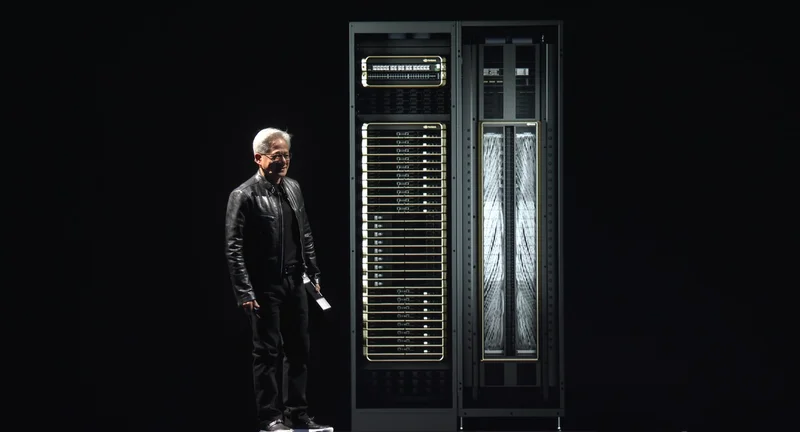
And this is the part of the report that I find genuinely puzzling. Huang is a notoriously precise, detail-oriented leader. For him to use such a broad, undefined figure suggests its purpose is more about shaping a story than providing a concrete data point. The story is one of American re-industrialization, powered by Nvidia’s silicon.
The more grounded, and frankly more credible, part of Huang’s vision is his commentary on the labor required to build this future. He spoke of a coming boom for skilled trades—plumbers, electricians, technicians—the people who will physically construct these “magnificent factories.” He claims we’ll need hundreds of thousands of them, maybe even millions. This isn't hype; it's a simple, observable bottleneck. You can't build a cutting-edge semiconductor fab with software engineers alone. The demand for skilled craft labor to build and maintain these facilities will be astronomical. This is where the AI revolution leaves the cloud and hits the concrete. It’s a tangible, verifiable economic ripple effect that is far more certain than any half-trillion-dollar market projection.
A Masterclass in Political Hedging
So, why the selective history? Why credit the tariffs so explicitly while the CHIPS Act goes unmentioned? The answer, I suspect, has very little to do with economic history and everything to do with corporate strategy and risk management.
Nvidia’s entire business model depends on a stable geopolitical environment and a secure supply chain. The company designs the world’s most advanced chips, but it has historically relied on TSMC in Taiwan to actually make them. This concentration of manufacturing in a geopolitical hotspot is the single greatest risk to Nvidia and, by extension, to the entire global tech industry. Bringing a portion of that manufacturing to the US isn't just a business decision; it's a strategic imperative. It’s about de-risking the entire enterprise.
This de-risking process requires immense political goodwill from both sides of the American political aisle. The CHIPS Act was a bipartisan initiative, but it was championed and signed by the current administration. By praising Trump’s earlier policies, Huang performs a delicate balancing act. He validates the Republican-led focus on tariffs and "reindustrialization" while his company simultaneously benefits enormously from the Democrat-led subsidy program.
He’s not just telling a story about the past; he’s future-proofing his company. He is ensuring that no matter who occupies the White House next January, Nvidia is seen as a partner in the mission to restore American manufacturing prowess. It’s a calculated political hedge, executed in public. He’s essentially thanking the previous administration for starting the car and the current one for filling the tank with gas, ensuring he has a good relationship with whoever might be driving next. What’s the cost of a few friendly words on a Sunday morning show compared to the benefit of insulating a $4 trillion company from political risk? It’s a rounding error.
This Isn't History, It's Insurance

- Search
- Recently Published
-
- Duke Energy: What's Really Going On?
- Value City Furniture: Are they finally going out of business? The bankruptcy talk.
- Scott Bessent: Who Is This Guy, The Trump Whispers, And What Are They Not Telling Us?
- American Signature Files Chapter 11: What Happened?
- Tesla Ride-Hail in Arizona: What This Means for the Future of Mobility
- OECD: What it is, and its AI Data Focus
- Nebius: Stock, Coreweave, & Nvidia – What's the Real Deal?
- Bitcoin: Beyond the Headlines, What This Moment Truly Signals
- Social Security Retirement: The Realities of Your Payouts and How to Plan
- Starlink Satellites: How Many Are Really Up There, Where They're Hiding, & What's The Actual Point?
- Tag list
-
- carbon trading (2)
- financial innovation (2)
- blockchain technology (2)
- carbon tokens (2)
- Blockchain (11)
- Decentralization (5)
- Smart Contracts (4)
- Cryptocurrency (26)
- DeFi (5)
- Bitcoin (29)
- Trump (5)
- Ethereum (8)
- Pudgy Penguins (5)
- NFT (5)
- Solana (7)
- cryptocurrency (6)
- XRP (3)
- Airdrop (3)
- MicroStrategy (3)
- Stablecoin (3)
- Digital Assets (3)
- PENGU (3)
- Aster (8)
- Zcash (6)
- iren stock (3)