Bucky Irving's Injury: The Latest Update and Fantasy Football Implications
An asset’s value is a function of its perceived future production. On Sunday, the market’s valuation of Bucky Irving, the second-year running back for the Tampa Bay Buccaneers, was stable. He commanded a 76% opportunity share in the team's offense, a metric that signals a "workhorse" designation. Then came the event: a significant hit during the game against the Philadelphia Eagles. Irving left the field, missed a handful of plays, and then returned. He finished the game without any visible signs of lingering distress.
On the surface, this is a negligible data point. A player endures a physical impact and returns to action. It happens dozens of times in every NFL game. The initial market reaction was, correctly, muted.
The signal that shifted the valuation model arrived on Monday. Head Coach Todd Bowles confirmed Irving was scheduled for an MRI. When asked if Irving's injury was among those causing concern for the team, his response was clinically vague yet directionally clear: "Yeah, he’s one of them." This statement, devoid of specifics, created a data vacuum. And markets, whether for equities or for fantasy football assets, abhor a vacuum. The subsequent reaction from the community of fantasy managers, which functions as a large, anecdotal data set for sentiment, has been a textbook example of pricing in worst-case-scenario risk based on incomplete information.
The online chatter immediately pivoted to multi-week absence scenarios. Speculation, largely centered on a sprained ankle, has coalesced around a potential 3-4 week timeline. This projection is not entirely baseless (it aligns with moderate sprain recovery periods), but it remains an assumption built upon an assumption. The market is now forcing managers to make tangible capital allocation decisions—waiver wire bids—on the basis of a non-specific coach’s comment and the scheduling of a diagnostic test. The result is a predictable re-pricing of adjacent assets. Rachaad White, the former starter, is now projected by analysts to become a "must-start RB2," while Sean Tucker is being modeled as a "touchdown-dependent RB4." These are, in effect, new valuations based on anticipated market share redistribution.
When Volume Masks a Valuation Problem
An Analysis of the Core Asset ###
Before assessing the validity of the market panic, a proper analysis requires a look at the fundamentals of the asset in question. Is Bucky Irving’s production profile as robust as his 76% opportunity share suggests? The volume is undeniable. He is the focal point of the Buccaneers' ground game. His fantasy output reflects this, averaging 18.0 points per game. Volume is a powerful driver of value.
However, a look at his efficiency metrics reveals a significant discrepancy. Irving is averaging just 3.3 yards per carry this season. This is a sub-optimal figure that suggests his high fantasy scoring is a product of sheer opportunity rather than elite performance. The volume masks the inefficiency. And this is the part of the profile that I find genuinely puzzling from a team management perspective. To commit such a high percentage of offensive touches to a player with that level of per-touch production points to a systemic issue, either with the player, the offensive line, or both. The market seems to have been pricing him based on the 18.0 PPG figure, without adequately discounting for the unsustainable efficiency underpinning it.
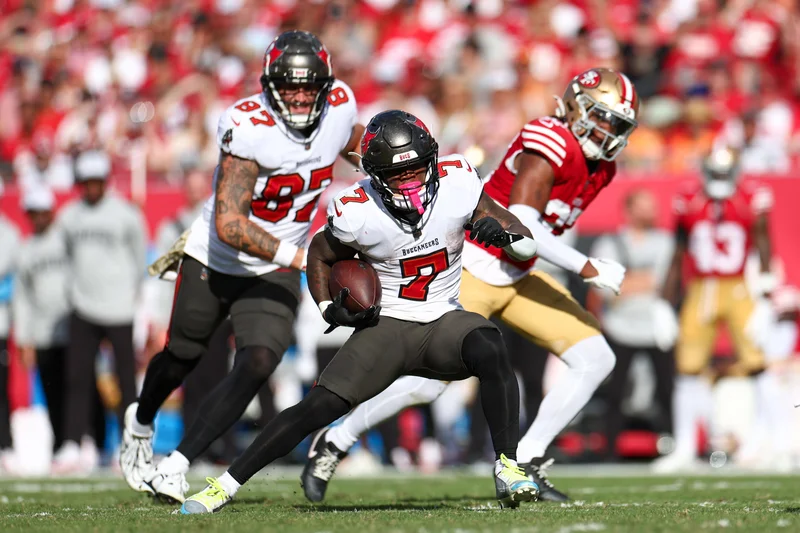
The primary issue here is the methodology of information dissemination from the source. Coach Bowles’s statement is a masterclass in ambiguity. It provides just enough negative information to stoke fear but not enough for a rational valuation. Details on the nature of the injury remain scarce, but the impact of that scarcity is clear. It’s a communication strategy that maximizes internal leverage while creating extreme external volatility. One has to question if this level of opacity is a deliberate strategic choice or simply standard operating procedure.
This brings us to the replacement assets. Rachaad White, who began the prior season as the starter, represents a known quantity. He is not a speculative play; there is a historical data set of his performance as a lead back. Sean Tucker, conversely, is projected for a highly specialized role in short-yardage and goal-line situations. This makes him a far more volatile asset. His value will be derived from a small number of high-leverage touches, a classic boom-or-bust production profile. The market is trying to price both of these contingent assets simultaneously, with the primary variable—Irving's recovery timeline—still listed as "to be determined."
The consensus speculation centers on a multi-week absence, perhaps 3-4 weeks—to be more exact, the consensus model for a Grade 2 ankle sprain projects a 24-day recovery window on average. The decision by the team to order an MRI suggests the initial on-field evaluation was inconclusive, or concerning enough to warrant a more granular look. An MRI can reveal damage that a physical examination cannot (ligament tears or bone bruises, for instance), which is why the market is reacting more to the test than to the initial injury event. The test itself is the signal that the initial data point of "he returned to the game" may be misleading.
What we are witnessing is a classic market overreaction to uncertainty. The fear of a multi-week absence, a "zero" in the production column, is causing managers to divest from Irving and over-invest in the perceived security of his replacements. The true analytical play is not to speculate on the MRI results. It is to re-evaluate the asset based on the now-exposed fragility of his production model. The injury has simply served as the catalyst for a market correction that, based on his efficiency numbers, was arguably overdue.
---
The Inefficiency of Ambiguity ###
The collective anxiety over Bucky Irving’s MRI is a misallocation of analytical capital. The core of this situation is not the injury itself, but the market's inability to properly price an asset in a low-information environment. The real signal was never the hit, nor the coach's vague commentary. The signal has been there all season: a running back with a workhorse-level opportunity share but a replacement-level efficiency of 3.3 yards per carry. His valuation was a bubble inflated by volume. The injury isn't the event; it's merely the pin.
Reference article source:

- Search
- Recently Published
-
- Duke Energy: What's Really Going On?
- Value City Furniture: Are they finally going out of business? The bankruptcy talk.
- Scott Bessent: Who Is This Guy, The Trump Whispers, And What Are They Not Telling Us?
- American Signature Files Chapter 11: What Happened?
- Tesla Ride-Hail in Arizona: What This Means for the Future of Mobility
- OECD: What it is, and its AI Data Focus
- Nebius: Stock, Coreweave, & Nvidia – What's the Real Deal?
- Bitcoin: Beyond the Headlines, What This Moment Truly Signals
- Social Security Retirement: The Realities of Your Payouts and How to Plan
- Starlink Satellites: How Many Are Really Up There, Where They're Hiding, & What's The Actual Point?
- Tag list
-
- carbon trading (2)
- financial innovation (2)
- blockchain technology (2)
- carbon tokens (2)
- Blockchain (11)
- Decentralization (5)
- Smart Contracts (4)
- Cryptocurrency (26)
- DeFi (5)
- Bitcoin (29)
- Trump (5)
- Ethereum (8)
- Pudgy Penguins (5)
- NFT (5)
- Solana (7)
- cryptocurrency (6)
- XRP (3)
- Airdrop (3)
- MicroStrategy (3)
- Stablecoin (3)
- Digital Assets (3)
- PENGU (3)
- Aster (8)
- Zcash (6)
- iren stock (3)