The Zcash Price Surge: Price Analysis, Future Outlook, and What the Reddit Hype Misses
The recent price action in Zcash (ZEC) has been an exercise in statistical improbability. An asset left for dead, bleeding value for the better part of a decade, suddenly registers a monthly gain of over 150%—to be more exact, 159% from its September 1st low. Its market capitalization ranking jolted from 92nd to 64th in less than two weeks. Google searches for the term "zcash" exploded from a baseline of relative obscurity to record highs.
This is the kind of outlier event that demands a root cause analysis. The narrative being propagated across social media is that Zcash has found a new purpose: it is "insurance against Bitcoin." The thesis is elegant. If Bitcoin is the transparent, auditable digital gold, then Zcash is the private, untraceable digital cash needed to transact freely in an era of increasing surveillance. It’s a compelling story. My objective, however, is not to evaluate the story, but to determine if the data supports it.
When Narrative Outperforms Technology
The Anatomy of a Multi-Year Decline
Before we analyze the recent vertical ascent, we must first establish a baseline. And for Zcash, the baseline is overwhelmingly bearish. The coin launched on October 28, 2016, with immense hype, leading to a brief, anomalous all-time high of $3,191.93 driven by microscopic initial supply. That number is pure noise and should be discarded from any serious analysis.
What followed was a more telling pattern of decay. After the initial frenzy, ZEC collapsed to just $48 by the end of 2016. It saw a brief, market-wide resurgence in the 2017 crypto mania, peaking around $830, but the subsequent crash was catastrophic. In 2018, the asset lost 90% of its value, falling from an open of $577 to a close of $56. The years that followed were a slow grind down, marked by regulatory headwinds that targeted privacy coins specifically. Exchanges in Japan, Australia, and South Korea delisted it. By 2023, with global exchanges like OKX following suit, Zcash hit a low of $21.30.
For eight years, the market rendered a clear verdict: despite its sophisticated zk-SNARKs technology, Zcash was a failing project from an investment perspective. The long-term chart is not a picture of resilience; it is a portrait of capital flight. This is the context required to properly assess the events of September 2025. A 159% monthly gain is not a recovery; it’s a statistical deviation from a firmly established downtrend.
The question, then, is what changed? It wasn't a fundamental protocol breakthrough. The last major upgrade, NU5, was in May 2022. The catalyst appears to be almost entirely memetic, sparked by a handful of influential figures. AngelList founder Naval Ravikant’s statement that "Zcash is insurance against Bitcoin" provided the perfect, digestible slogan. He was amplified by others, like Helius CEO Mert Mumtaz, who framed Zcash as an essential tool against the rise of Central Bank Digital Currencies (CBDCs).
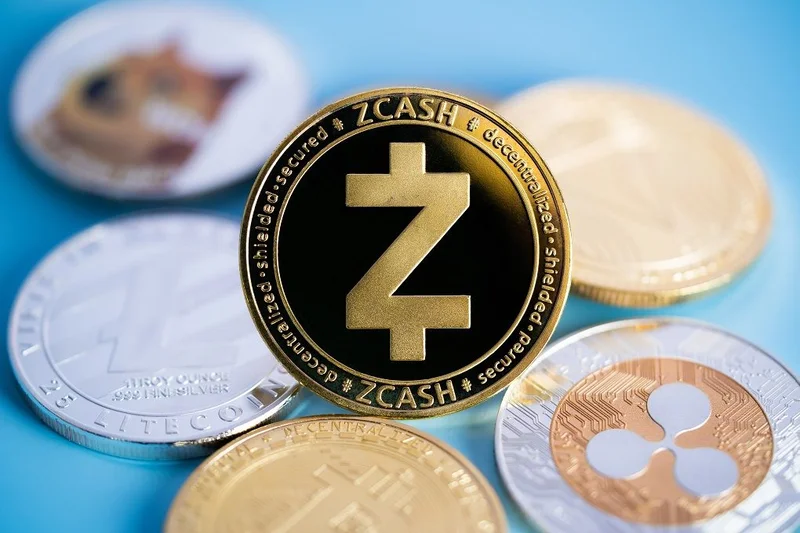
And this is the part of the data I find genuinely fascinating. For years, the core value proposition was a technical argument about zero-knowledge proofs and optional privacy. It was complex, nuanced, and failed to sustain investor interest. Now, a single, easily marketable phrase appears to have done what years of cryptographic development could not: generate a massive speculative inflow. The correlation is undeniable. The influencer commentary begins, and Google Trends data for "zcash" and "privacy coins" immediately spikes. This was not a move driven by adoption; it was a move driven by attention.
A Thesis in Search of On-Chain Evidence
A Discrepancy Between Narrative and Use
If the "insurance against Bitcoin" thesis were valid, we would expect to see it reflected in on-chain fundamentals. We would look for evidence that users are actively seeking the privacy Zcash offers. The data, however, presents a significant discrepancy. According to the project's own metrics, as of July 2025, only around 20% of the circulating ZEC supply is stored in shielded addresses (the coin's core privacy feature).
This is a critical point. If 80% of the asset is being held and transacted on transparent addresses, then it is functioning as a less secure, less popular version of Bitcoin. The primary use case, the very thing that underpins the new narrative, is being ignored by the vast majority of its holders. The surge in price has not been met with a corresponding surge in shielded adoption. The market is buying the story of privacy, not the utility of it.
Further, let's examine the market's structure. The rally has been characterized by extreme volatility, with 24-hour swings exceeding 50%. Technical indicators like the StochRSI (at 100) show extreme overbought conditions, signaling the possibility of a sharp pullback. While analysts point to bullish formations like a "golden cross," these patterns are less reliable in an asset class driven more by narrative contagion than by traditional market mechanics.
The long-term price predictions cited in market reports only highlight the speculative nature of the asset. Forecasts for 2040 range from a moderate $1,100 to an astronomical $51,000. I must pause here for a methodological critique. Such long-range predictions are functionally useless. They are model-driven extrapolations that cannot account for the primary risk factor for a privacy coin: regulation. A single piece of legislation in a major jurisdiction could render Zcash untradable on regulated exchanges, making any price target meaningless. These are not serious analyses; they are marketing collateral. The extreme divergence in these predictions reveals that the models have no real, fundamental anchor to ground them.
What we are witnessing is a classic feedback loop. A compelling narrative creates an initial price spike, which draws in momentum traders. The rising price validates the narrative for a new wave of buyers, and the cycle repeats. The problem is that such loops are inherently unstable. They require a constant injection of new capital and increasing belief in a story that is, at present, not supported by the on-chain data.
An Outlier in Search of a Thesis
The 2025 Zcash rally is a case study in narrative arbitrage. The underlying fundamentals have not materially changed. Shielded adoption remains a minority use case. What changed was the marketing. The "insurance against Bitcoin" slogan is potent, but it remains a speculative thesis, not an observed reality. The data shows people are buying the idea of Zcash, not actively using its core feature. This disconnect between price and utility is a significant vulnerability. The risk is that the narrative fades as quickly as it appeared, leaving the price untethered from any quantifiable value and re-coupling it to its long-term trajectory of decay. The market is not rewarding Zcash for what it is; it is rewarding it for what a few influential voices claim it could be.
Reference article source:

- Search
- Recently Published
-
- Duke Energy: What's Really Going On?
- Value City Furniture: Are they finally going out of business? The bankruptcy talk.
- Scott Bessent: Who Is This Guy, The Trump Whispers, And What Are They Not Telling Us?
- American Signature Files Chapter 11: What Happened?
- Tesla Ride-Hail in Arizona: What This Means for the Future of Mobility
- OECD: What it is, and its AI Data Focus
- Nebius: Stock, Coreweave, & Nvidia – What's the Real Deal?
- Bitcoin: Beyond the Headlines, What This Moment Truly Signals
- Social Security Retirement: The Realities of Your Payouts and How to Plan
- Starlink Satellites: How Many Are Really Up There, Where They're Hiding, & What's The Actual Point?
- Tag list
-
- carbon trading (2)
- financial innovation (2)
- blockchain technology (2)
- carbon tokens (2)
- Blockchain (11)
- Decentralization (5)
- Smart Contracts (4)
- Cryptocurrency (26)
- DeFi (5)
- Bitcoin (29)
- Trump (5)
- Ethereum (8)
- Pudgy Penguins (5)
- NFT (5)
- Solana (7)
- cryptocurrency (6)
- XRP (3)
- Airdrop (3)
- MicroStrategy (3)
- Stablecoin (3)
- Digital Assets (3)
- PENGU (3)
- Aster (8)
- Zcash (6)
- iren stock (3)